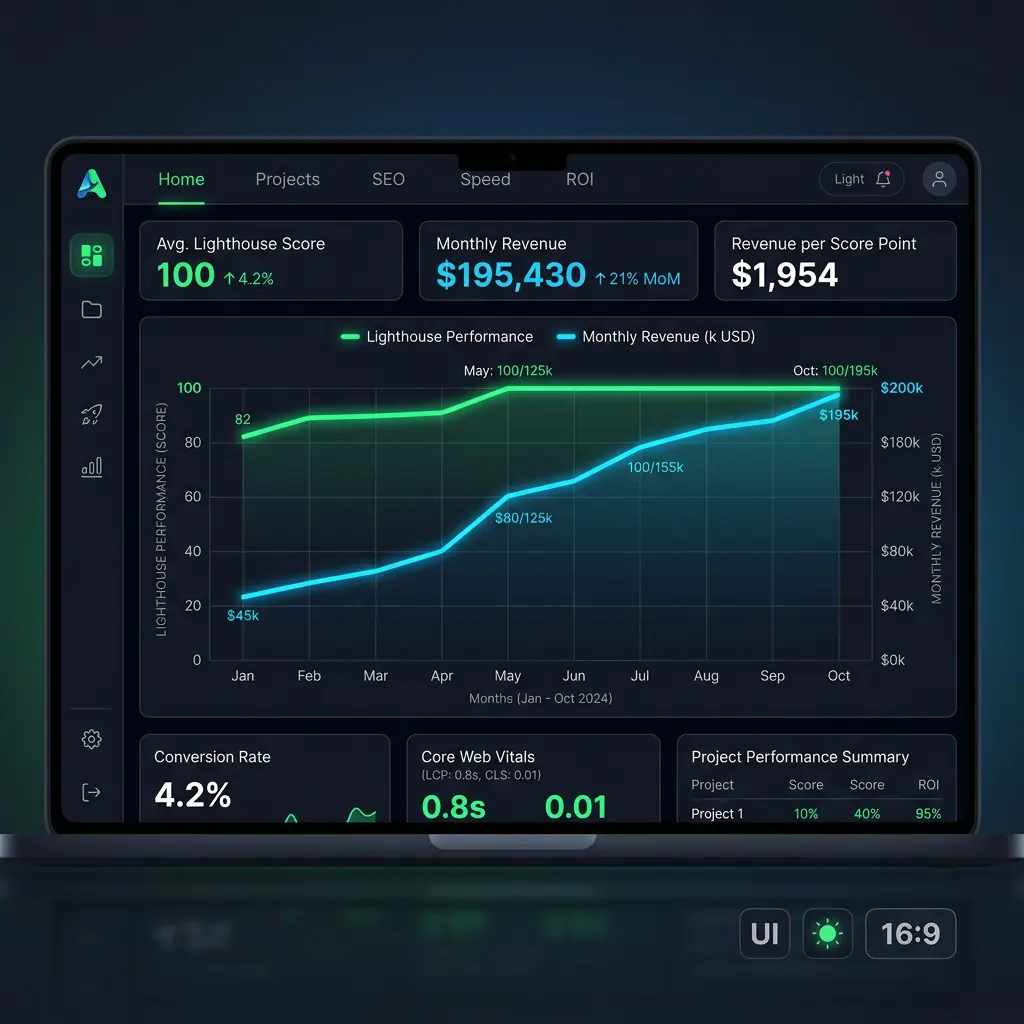
Core Web Vitals: The Only Metrics That Actually Pay the Bills
As a business owner, you are likely bombarded with a confusing alphabet soup of marketing metrics: CTR, CPA, ROAS, bounce rates, and page views. While these traditional marketing KPIs are important for measuring the efficiency of an advertising campaign, they completely ignore the structural foundation that actually enables those campaigns to succeed: Website Performance.
In the 2026 digital economy, driving traffic to a slow website is the commercial equivalent of pouring expensive fuel into a car with a broken engine.
To bridge the gap between technical web development and tangible business revenue, Google introduced a standardized set of performance metrics known as Core Web Vitals.
In this guide, we are going to strip away the technical jargon, translate these complex Lighthouse metrics into plain English, and show you exactly how fixing them directly correlates to an increase in your monthly revenue.
1. What Are Core Web Vitals?
Core Web Vitals are a specific subset of metrics that Google uses to evaluate the real-world user experience of a webpage. Google has explicitly stated that these vitals are a direct ranking factor in their search algorithm.
If your website fails Core Web Vitals, Google views it as a substandard digital experience and will intentionally push your site down in the search results, giving your direct competitors the prized top spots.
While the engineering behind these metrics is complex, they measure three incredibly simple human experiences:
- Loading Speed: How fast does the main content appear?
- Interactivity: How quickly does the site respond when I tap or click?
- Visual Stability: Does the page jump around unexpectedly while I am trying to read it?
Let’s break these down into their actual technical terms and translate their commercial impact.
2. Largest Contentful Paint (LCP): The First Impression
What it means: Largest Contentful Paint measures how quickly the largest single element—usually a hero image, a video, or a massive block of text—renders on the screen. The Goal: Google requires your LCP to be under 2.5 seconds.
The Commercial Translation
LCP is the digital equivalent of a customer walking into your store. If your LCP takes 6 seconds (which is disastrously common on legacy WordPress sites), the customer is essentially standing in complete darkness waiting for the lights to turn on.
A high LCP time destroys the perceived credibility of your brand. E-commerce data analysis proves that a 1-second delay in page load time yields a 7% reduction in conversions. If you are a boutique retailer doing £10,000 a month in online sales, a 2-second LCP delay is costing you at minimum £16,800 a year in abandoned revenue.
The Solution
Instead of relying on heavy PHP processing, modern frameworks pre-render your website into incredibly fast static HTML. By optimizing images using next-generation formats (like WebP and AVIF) and serving the site via a global Content Delivery Network (CDN), they mathematically guarantee an LCP well under the 2.5-second threshold.
3. Interaction to Next Paint (INP): The Frustration Factor
What it means: Replacing the older FID (First Input Delay) metric, INP measures the overall responsiveness of your page to user interactions (like clicks, taps, and keyboard inputs) throughout the entire lifespan of the user’s visit. The Goal: Google requires your INP to be under 200 milliseconds.
The Commercial Translation
We discussed this briefly in our previous guide on Hydration. INP is a measure of digital frustration. If a user taps your “Add to Cart” or “Request a Quote” button and the site hesitates for a half-second before responding, the user feels a subliminal spike of anxiety. They wonder if the button is broken. They wonder if their payment went through twice.
High INP scores are typically caused by massive, bloated JavaScript files completely freezing the user’s phone browser.
The Solution
Frameworks relying entirely on Client-Side Rendering (like traditional React single-page apps) struggle immensely with INP because they force the phone to do all the heavy lifting. Component Isolation architectures, which carefully strip away non-essential JavaScript and only activate interactive components precisely when they are needed, are currently the industry gold standard for achieving a near-perfect INP score.
4. Cumulative Layout Shift (CLS): The Trust Destroyer
What it means: Cumulative Layout Shift measures visual stability. It calculates how much the page unexpectedly moves around as it loads. The Goal: Google requires your CLS score to be under 0.1.
The Commercial Translation
You have almost certainly experienced a terrible CLS score. You are reading an article on a news site, you go to tap a link to continue reading, and suddenly a massive banner advertisement loads at the top of the screen. The entire page violently jolts downward, and you accidentally click an ad you never intended to click.
This is a terrible user experience. For a business, a high CLS score looks scammy, disorganized, and deeply unprofessional. If your layout shifts while a user is trying to read your pricing table, they will lose trust in your technical competence and leave.
The Solution
CLS issues are almost entirely caused by unoptimized images without explicit width and height dimensions, dynamically injected ads, or custom web fonts loading late and resizing the text. By explicitly defining the space required for every single image and component before it loads, developers enforce rigid digital structure, driving the CLS score down to a flawless zero.
5. The Architecture of Revenue
Understanding Core Web Vitals is no longer the exclusive domain of an IT department. These metrics are the direct digital pulse of your business’s revenue-generating capability.
If you are paying a monthly retainer for Search Engine Optimisation (SEO) but your web agency allows your site to continuously fail Google’s Core Web Vitals assessment, you are wasting your money. No amount of keyword research or backlink building can override Google’s algorithmic penalty for a slow, frustrating website.
At AHM Labs, we don’t just build pretty websites. We engineer high-performance digital infrastructure using these modern frameworks because our clients don’t just want traffic—they want revenue. And perfect Core Web Vitals are the only metrics that actually pay the bills.