The 2026 Technical SEO Audit: Why Your WordPress Site is Bleeding Leads
The digital landscape for Small and Medium-Sized Enterprises (SMEs) in the United Kingdom has entered a highly unforgiving phase in 2026. If you’re running a business today, you’re likely battling severe margin compressions, escalating supply chain costs, and the persistent challenge of late payments. Amidst this macroeconomic turbulence, consumer behavior has fundamentally shifted. Your website is no longer just a digital brochure; it is the frontline of your commercial survival.
And yet, thousands of UK SMEs are actively hemorrhaging leads every single day because their websites are built on bloated, legacy content management systems (CMS) like WordPress.
In this comprehensive, 12-minute technical SEO audit, we are going to dissect exactly why your legacy WordPress site is failing to convert, explore the catastrophic impact of slow mobile load times, and explain why modern high-performance frameworks have become the commercial imperative for 2026.
1. The Eradication of Desktop-First Methodologies
If your web agency built your website primarily by looking at it on a large desktop monitor, they have committed architectural malpractice.
In the 2026 digital economy, the overwhelming majority of traffic directed toward UK small business websites originates from mobile devices. These devices frequently operate on constrained, fluctuating, or latency-heavy cellular connections like 4G or spotty 5G as users commute, walk through city centers, or browse on the go.
Because of this undeniable reality, Google’s indexing infrastructure operates on a mobile-first paradigm. This means Google evaluates the performance, layout, and content of your mobile site exclusively when determining where you rank in search results. Your desktop experience is practically irrelevant to Google’s algorithm.
The Mathematics of Mobile Speed
When a prospective client taps a link to your site from a Google search or a LinkedIn post, a psychological stopwatch begins.
- Under 1.5 seconds: The user feels the experience is instant. Trust is established.
- Between 1.5 and 3 seconds: Friction begins. The user is consciously aware they are waiting. Bounce rates begin to climb steadily.
- Over 3 seconds: You have lost them. Over 53% of mobile users will abandon a site altogether if it takes longer than 3 seconds to load.
If your website suffers from slow load times, every other digital investment you make—from beautiful bespoke typography, compelling copywriting, and brand photography, all the way to expensive Pay-Per-Click (PPC) and paid social campaigns—is rendered mathematically irrelevant. You are paying for clicks that never mature into page views.
2. Deconstructing the ‘WordPress Tax’
WordPress currently powers over 40% of the web. It gained popularity because it was accessible, open-source, and allowed non-developers to build sites using visual page builders (like Elementor or Divi) and thousands of third-party plugins.
However, in 2026, the architectural foundation of WordPress is fundamentally flawed for high-performance lead generation. We call this the “WordPress Tax.”
How Legacy CMS Platforms Load (Client-Side Rendering)
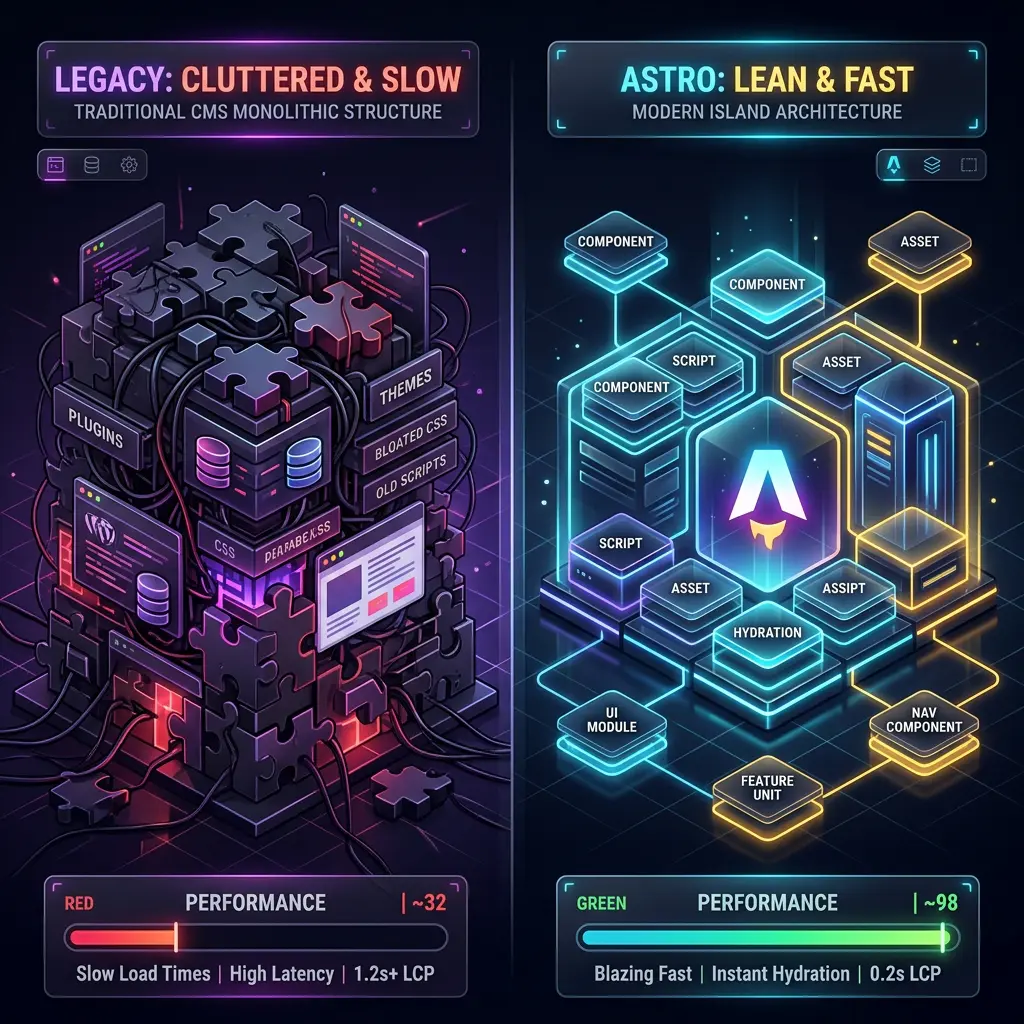
When a user requests a page on a traditional WordPress site, the server doesn’t just hand over a finished webpage. Instead, it triggers a computationally heavy sequence of events:
- Database Queries: The server must ask multiple interconnected database tables for the page content, the author details, the site settings, and the menu structure.
- PHP Execution: Next, the PHP engine must stitch all this data into a template on the fly.
- The Plugin Avalanche: Every single active plugin (whether it’s an SEO tool, a caching plugin, a lead generation pop-up, or an analytics tracker) must inject its own CSS styles and JavaScript files into the page.
- Client-Side Rendering: Finally, a massive payload of code is sent over the cellular network to the user’s mobile browser, which must desperately try to download, parse, and execute megabytes of JavaScript before the page becomes interactive.
This process causes massive spikes in Time to First Byte (TTFB) and completely destroys your Largest Contentful Paint (LCP)—two of the most critical Core Web Vitals metrics that Google uses to rank your site.
Every single unnecessary plugin script that loads is acting like a physical weight tied to your website, dragging it down the search rankings.
3. The Generative Engine Optimisation (GEO) Reality
You might think, “My site is a bit slow, but my SEO is great because I stuffed keywords on every page.”
This mindset is entirely obsolete. The mechanics of online discovery have fractured and evolved dramatically. Traditional Search Engine Optimisation—which historically focused on matching broad keywords to user queries to capture a direct click—is no longer the terminus of digital marketing.
By 2026, AI-first search experiences, including Google’s AI Overviews and the deep integration of Large Language Models (LLMs) into discovery platforms, have become the default standard. Search is now conversational, intent-driven, and highly contextual.
Supplying the AI Brain
The contemporary objective of SEO is to feed these advanced AI systems the clearest, most structured possible understanding of your business’s core entity: precisely who you are, what specific services you provide, and why you possess undeniable topical authority in your vertical.
If your legacy WordPress site is slow and choked with code bloat, AI crawlers experience friction. Generative engines will simply ignore you in favor of clearer, faster, more definitive entities. Technical performance is the mandatory baseline; it removes crawl friction, allowing AI systems to index and understand your site instantly without expending unnecessary computational resources.
4. The Paradigm Shift: Ship Zero JavaScript
To differentiate your business, you must operate on digital infrastructure that fundamentally alters the performance paradigm. This is why our agency, AHM Labs, exclusively champions a modern, high-performance web architecture.
This architecture operates on a philosophy known as “content-first, JavaScript-last.” It provides a massive, unfair competitive advantage straight out of the box.
Server-Rendered HTML
Unlike WordPress which renders pages dynamically on the fly, a modern architecture operates by shipping fully server-rendered HTML with zero structural JavaScript by default.
When a search engine crawler or a human visitor requests an optimized page, they receive a fully formed, ready-to-serve webpage immediately. There is no waiting for database queries to resolve. There is no waiting for templates to stitch together. There is no heavy framework runtime to download.
By stripping away framework runtimes and unused bundle code entirely, we significantly reduce page weight, resulting in a remarkably fast Time to First Byte (TTFB) and perfect performance scores.
The ‘Component Isolation’ Advantage
Modern websites still require interactivity—like dynamic contact forms, complex pricing calculators, or shopping carts. We achieve this without slowing down the rest of the page through a revolutionary approach known as Component Isolation.
Instead of loading JavaScript for the entire page, we isolate necessary interactive elements as highly functional, localized “islands” within a broader sea of fast, static HTML. For example:
- The text and images load instantly as pure HTML.
- Only the specific component that needs JavaScript (e.g., the lead capture form) loads a tiny, optimized script.
This approach ensures that pages feel instant to the user. It completely removes the technical SEO obstacles that perpetually plague competing development frameworks.
5. The Commercial Baseline Requirement
Your website cannot exist in a vacuum. It is an aggressive, high-performance engine for acquisition.
If you are a UK SME owner running a service business or a boutique e-commerce store, a slow website is actively subsidizing your competitors. Every time a user bounces from your site because a bloated slider plugin or a heavy WordPress theme failed to load on their 4G connection, they immediately click the next result—your direct competition.
The transition to a structurally immaculate, modern web architecture is not merely an IT upgrade; it is a fundamental, urgent commercial strategy. It protects your profit margins, drastically decreases customer acquisition costs by maximizing your ad spend efficiency, and builds profound digital resilience against macroeconomic shocks.
The era of the slow, bloated website is over. Stop paying the WordPress tax.
(Expect more from this series as we demystify the mechanics of the modern web. In Part 2, we will dive deep into “Hydration,” how data loading strategies trick your customers, and why speed directly correlates with trust.)